Restoring the Cottonwood Heights Old Mill would cost at least $34 million and likely lose millions for any private developer, according to consultants who presented their findings to the City Council on Oct. 20.
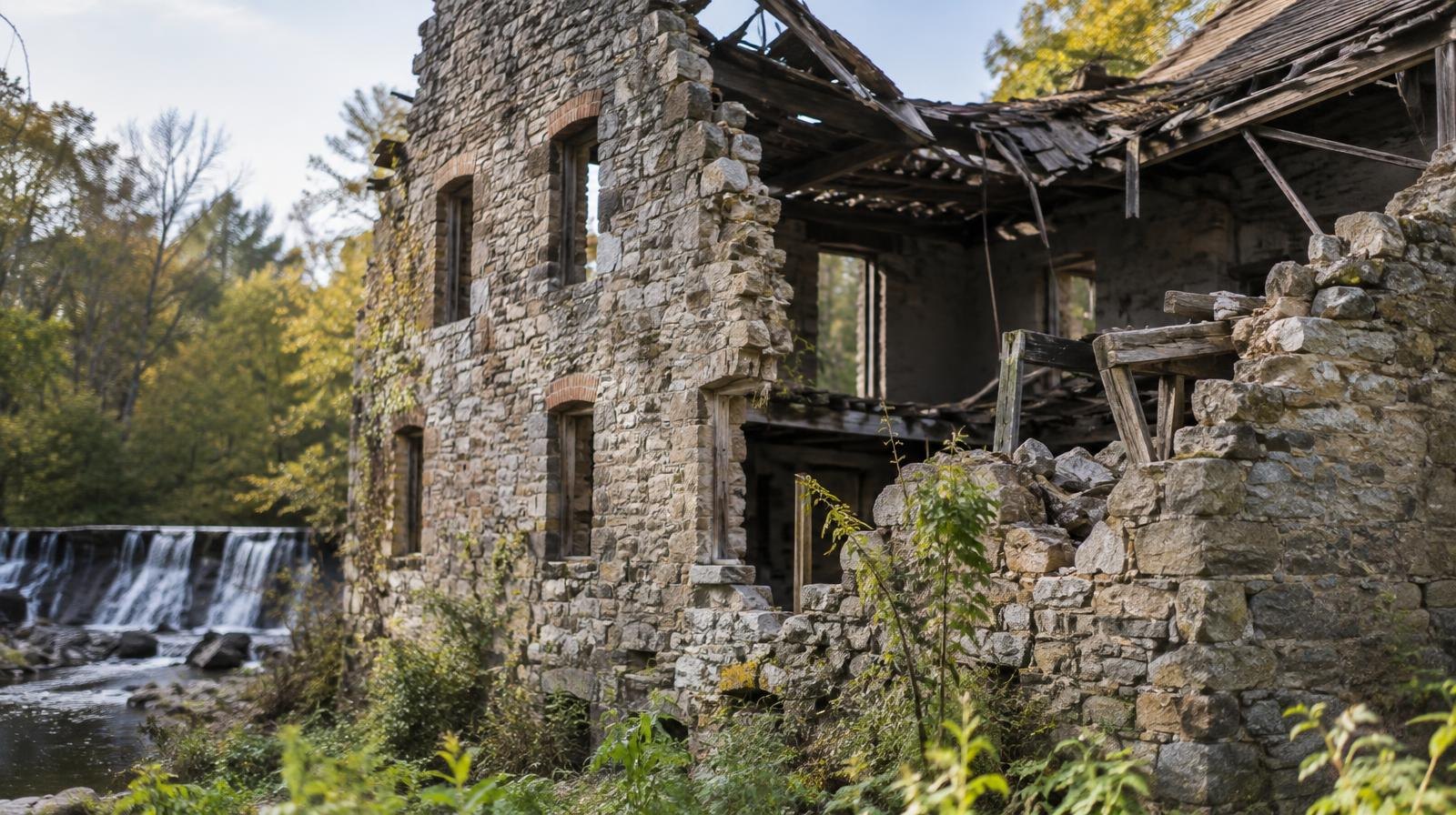
The city hired Dunn Associates and Aegis Project Controls to evaluate the 143-year-old granite structure at 6851 South Big Cottonwood Canyon Road. The property owner, Doug Shelby, has applied for a conditional use permit (CUP) to demolish the building, which is one of only two designated historic structures in Cottonwood Heights.
Community and Economic Development Director Jim Spung introduced the consultants at the council's work session. Tyler Wright of Dunn Associates presented the structural analysis, and Sean Flynn of Aegis Consulting reviewed cost estimates.
Too dangerous to enter
A drone was used to survey the interior because the roof had collapsed and the building was too unsafe for anyone to go inside, according to the meeting minutes. Wright reported that the condition was not unusual for an unreinforced masonry building of its age.
The consultants identified deficiencies throughout the structure. Walls were too tall and slender, with a tendency to bow during earthquakes. Floor-to-wall connections were inadequate. Rotting wood had weakened structural integrity, and the floor had collapsed in some areas. The site also sits at the edge of a surface fault rupture hazard zone, and soil conditions were unknown.
Three options, steep price tags
The consultants laid out three paths forward:
Stabilize in place: $6 million to $9 million. Steel bracing and new footings would hold the walls up, but the building could not be occupied or generate rental income. Further weathering would continue.
Repair and restore: $34.2 million to $51.3 million (midpoint $42.8 million). This would temporarily stabilize the granite walls, reframe floors and the roof, and add concrete shear walls inside.
Rebuild in historic form: $37 million to $55.5 million (midpoint $46.3 million). The existing building would be demolished, the granite cataloged and stored, then used as veneer on a new structure built in the original footprint.
Flynn told the council that even the preferred rebuild option would produce an estimated $11 million loss if the Old Mill stood alone. Folded into a larger master development of roughly $250 million in surrounding buildings, the projected loss would shrink to about $6 million.
Council sees no private incentive
Council Member Suzanne Hyland said the report showed no incentive for a private developer to save the Old Mill. Mayor Gay Lynn Bennion agreed, noting the city was fortunate to have engaged citizens reaching out to donors, but said the city was neutral on the matter.
Council Member Shawn Newell pointed out that the estimates did not include infrastructure costs. Flynn said infrastructure costs were typically a small portion of master development costs.
Spung told the council the property owner's demolition application would go to a Planning Commission public hearing in early 2027. City code requires the CUP application to sit before the Planning Commission for at least one year before a decision. If the commission approves the CUP, the owner must then seek a Certificate of Appropriateness from the City Council before any demolition can proceed.
Built in 1883, the Old Mill was added to the National Register of Historic Places in 1971. The city condemned the building in 2005 over seismic safety concerns, according to the structural analysis report.
The Planning Commission's next opportunity to act on the application is Jan. 21, 2027.