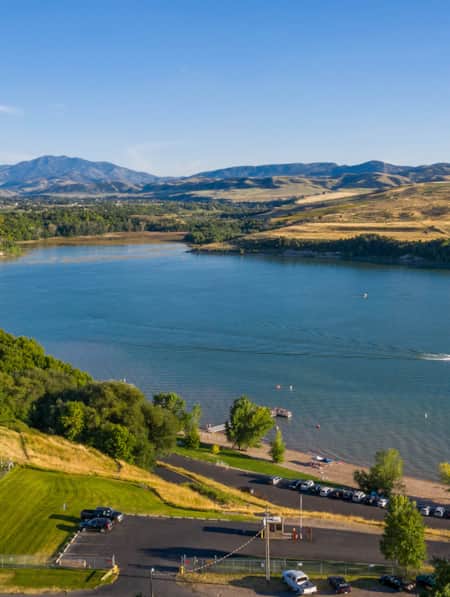
Utah's statewide reservoir storage fell to 54% of capacity as of Aug. 1, down 15 percentage points from 69% at the same time last year, according to the Natural Resources Conservation Service's July Utah Water Availability Update. The decline hits close to home: Big Cottonwood Canyon, the protected watershed that supplies roughly 60% of the Salt Lake Valley's drinking water according to the Cottonwood Canyons Foundation, feeds the system that serves Cottonwood Heights and portions of Holladay.
The drop came despite a wetter-than-normal July. High-elevation precipitation reached 2.2 inches, or 181% of normal, as measured by SNOTEL stations. Valley sites averaged 1.0 inch, or 143% of normal. Two SNOTEL stations on the south slope of the Uinta Mountains set new July precipitation records, and seven others logged their second-highest July totals ever.
Reservoirs kept falling.
The NRCS report, summarized by ABC4 on Tuesday, Aug. 4, found that summer monsoon storms improved soil moisture, supported vegetation and reduced wildfire risk without adding meaningfully to stored water supplies. Soil temperatures are at or near record highs in nearly every region of the state.
Water Availability Index readings remain critically low across Utah. The Weber-Ogden region registered just 6% for Ogden; Lower Sevier and Upper Sevier each hit 4%; and Price-San Rafael dropped to 2% for Joes Valley.
What it means locally
The Salt Lake City Department of Public Utilities supplies drinking water to approximately 90% of Cottonwood Heights addresses and portions of Holladay, drawing heavily from the Big Cottonwood Canyon watershed. The Jordan Valley Water Conservancy District serves the remaining roughly 10% of Cottonwood Heights, according to the city's Water Use and Preservation Element adopted in December 2025.
Joanna Wheelton, executive director of the Cottonwood Canyons Foundation, described the canyon's role in a July 14 interview with the Daily Utah Chronicle: "Every drop of precipitation that falls up here can make its way down to faucets in the valley in about 24 hours," she said. "Most people don't realize how quickly and efficiently this canyon provides 60 percent of the valley's drinking water."
As we reported July 15, record-low Colorado River storage and Utah's snow drought were already straining the local supply earlier this summer. The new NRCS data shows conditions have not improved heading into fall.
Cottonwood Heights' per capita water use stood at approximately 179 gallons per day as of 2024. The city's conservation target, aligned with Salt Lake City's 2025 Water Conservation Plan, calls for reducing that to 174 gallons per day by 2030.
Neither Cottonwood Heights nor Holladay officials were reached for comment on the July report. The next monthly NRCS water availability update is expected in early September.