The 57-acre former Cottonwood Mall site at 4800 S. Highland Drive just got $2.5 million closer to its first affordable housing units.
The Holladay Redevelopment Agency Board voted unanimously on Thursday, June 11, to release the funds to KMW Development for 100 affordable housing units in Block E of the Royal Holladay Hills project. All six board members voted yes: Emily Gray, David Sundwall, Drew Quinn, Natalie Bradley, Matt Durham, and Paul Fotheringham.
The money breaks down to $2 million from RDA budgets and $500,000 from a retention account. The units must serve households earning at or below 80% of the Salt Lake City metro area median family income. KMW must begin construction on that phase by May 1, 2028, or the RDA can terminate the agreement.
KMW Development is a joint venture of Woodbury Corporation and Millrock Capital II, with Steve Peterson as the primary contact. The firm is the master developer of the Cottonwood Mall Urban Renewal Project Area under a development agreement dating to April 2022.
Zoning changes moving forward
The Holladay Planning Commission held public hearings on Tuesday, June 16, on three zoning amendments tied to the redevelopment area: adding personal services as an allowed use in the Holladay Hills R-M/U zone, defining arts and culture uses for the Holladay Village Zone, and increasing allowable building heights from 35 feet to 50 feet at the corner of Holladay Boulevard and Arbor Lane. Those recommendations now await a City Council vote at a separately noticed meeting. No date for that vote has been publicly announced.
The RDA's Cottonwood Mall project area is projecting $2.8 million in revenue for fiscal year 2026-2027, a 2% increase over the prior year, with $3.05 million in budgeted expenditures including $1.7 million for construction services.
A regional comparison three miles north
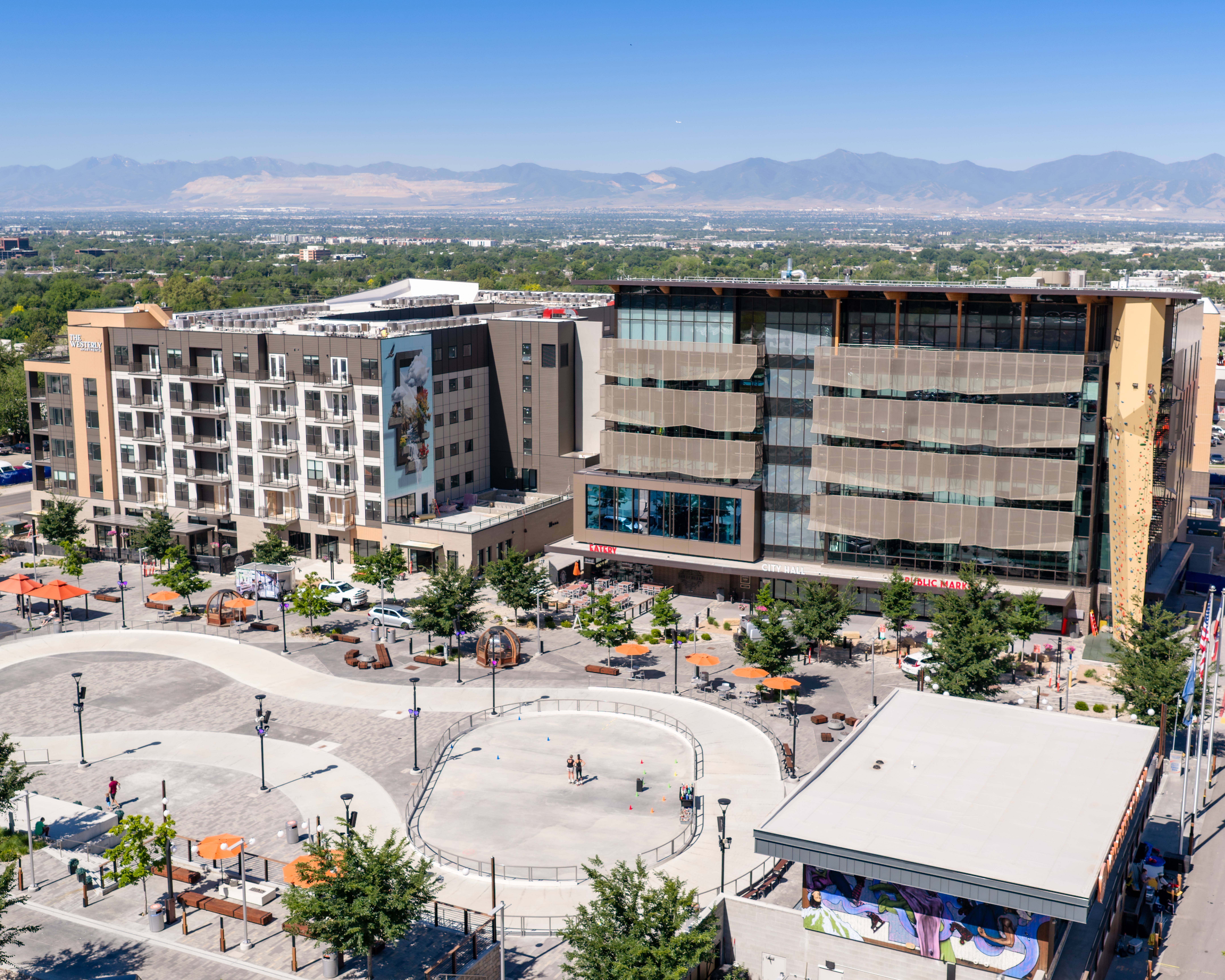
A Building Salt Lake analysis published Monday, July 20, details how neighboring Millcreek built a functioning mixed-use downtown from scratch since incorporating in 2016. The parallels to Holladay's project are visible: both involve large-scale mixed-use development along Highland Drive, public investment to attract private capital, and overlay zoning to shape density.
Millcreek's numbers are further along. City records shared with Building Salt Lake show 1,417 housing units, 235,556 square feet of commercial space, and 2,608 parking stalls now clustered around Millcreek Common, a public plaza along 3300 South.
Millcreek Mayor Mike Winder told Building Salt Lake that a federal opportunity zone designation drew private investment, while the city council approved a $20 million sales tax bond for public infrastructure, to be repaid through tax increment from new development. The city also turned a geological constraint into an asset: a fault line barring habitable structures became the site's central open space.
"On a fault line, you can't build a habitable structure on it, but you can build open space, you can build parks and plazas," Winder said. "So that made us think, 'Hey, we have some great bones in this area.'"
Francis Lilly, Millcreek's assistant city manager and planning director, said the city convinced developers to pause applications while staff created a City Center Overlay Zone encouraging greater building heights in exchange for higher-quality materials and ground-floor retail.
Holladay's next milestone: a City Council vote on the three zoning amendments the Planning Commission recommended June 16.
.jpg)