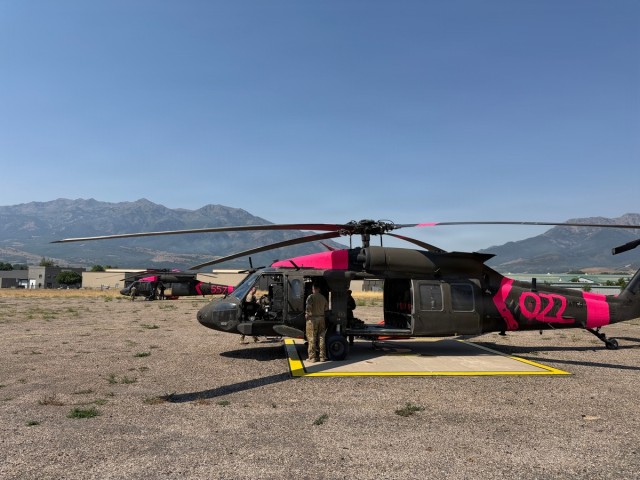
Utah National Guard Black Hawk helicopters are now flying daily firefighting missions from a base in West Jordan, just miles from Cottonwood Heights and Holladay, as fire officials say national resources are "heavily committed" and the mutual-aid system that backs up local canyon neighborhoods is stretched to capacity.
The Guard's 2nd Battalion, 211th General Support Aviation Regiment began operations Aug. 5, initially fighting the Black Canyon Fire in Sanpete County before shifting to the Rocky Canyon Fire in Summit and Morgan counties. Crews are dropping water from 530-gallon buckets, the U.S. Department of Defense announced Wednesday, Aug. 12. They fly from West Jordan to Morgan County each morning for briefings with fire managers before conducting direct attacks on flames, backburning and building protection.
The military escalation comes as the National Interagency Fire Center holds the U.S. at Preparedness Level 5, its highest ranking. Up to 250 fire specialists from Australia and New Zealand arrived in Boise the week of Aug. 11 to supplement stretched domestic crews, according to the Idaho Capital Sun.
"We're barely in August," Rocky Canyon Fire incident spokesperson Sierra Hellstrom told reporters Tuesday, Aug. 11. "This is usually when fire season actually starts to get big, let alone be in PL5 already."
What it means locally
For Cottonwood Heights and Holladay residents in canyon-adjacent neighborhoods, the timing compounds an already thin local safety net. The Unified Fire Authority, which serves both cities, deployed crews to Oregon on July 29 for a 14-day mutual-aid mission. That deployment would nominally end around Aug. 12, but UFA has not confirmed whether those firefighters have returned.
As we reported Aug. 5, UFA warned that simultaneous fires were stretching crews thin. A firefighter was treated for heat exhaustion at a July 31 Midvale apartment blaze. Homes in Holladay's Canyon Cove and Hughes Canyon areas face a new state wildfire risk assessment fee on property tax bills starting this fall, with state inspectors set to visit those canyon-adjacent properties.
The mutual-aid system that would normally backfill local gaps during a canyon fire is now occupied at every level. National Guard units in Idaho, Wyoming, Colorado, California and Washington have also been activated for wildfire duty. Gov. Spencer Cox's office directs Guard deployments through the Utah Department of Emergency Management after local authorities request help.
By the numbers
Utah has spent an estimated $33 million fighting wildfires in 2026, putting the state on track to exceed last year's record, according to Utah News Dispatch. More than 532,000 acres have burned statewide, making this the second-biggest wildfire year on record behind 2007's 629,200 acres. Deputy state fire management officer Wade Snyder said Tuesday, Aug. 11, the $33 million figure could grow by another third.
FEMA approved Utah's request for aid on the Rocky Canyon Fire, pledging to cover 75% of eligible suppression costs. The fire had grown to more than 15,600 acres and was 29% contained as of Wednesday, with evacuations still in place for the community of Henefer.
Lt. Col. Penny McCarthy, the battalion commander, said in a prepared statement that the mission is personal for Guard members with family near the fires. "It just hits different when it's our neighbors," McCarthy said.
Cottonwood Heights and Holladay residents in wildfire-prone areas can contact UFA for defensible-space guidance and should monitor air quality alerts as smoke from active fires drifts across the Salt Lake Valley.