Holladay fire and emergency crews responded to 607 incidents between July and September, a steady climb from the same quarter in each of the past two years, according to the Unified Fire Authority's quarterly report to the Holladay City Council.
UFA Capt. Dan Brown, the agency's Holladay liaison, was scheduled to present the data at the council's Thursday, Oct. 22, work session at Holladay Council Chambers, 3330 S. 1300 East.
Of the 607 calls, 112 were classified as emergent, about 18% of the total. The report does not define the criteria UFA uses to classify a call as emergent.
Call volume has ticked upward each Q3 period: 580 in 2024, 594 in 2025 and 607 in 2026. Monthly totals held relatively even across the quarter, with 200 incidents in July, 209 in August and 198 in September.
Medical calls dominate
Falls were the single largest call type, with 105 during the quarter. Sick-person calls came in at 44, followed by breathing problems at 35. Motor vehicle crashes and chest pain complaints each accounted for 23 calls.
Actual fires were rare. The top fire categories were utility fires, dumpster fires and construction-waste fires, each at two incidents. One outside fire and one confined cooking or appliance fire rounded out the list.
Lift assists totaled 25. Accidental alarms triggered 20 responses, and malfunctioning alarms added 16 more.
Station 104 carries the load
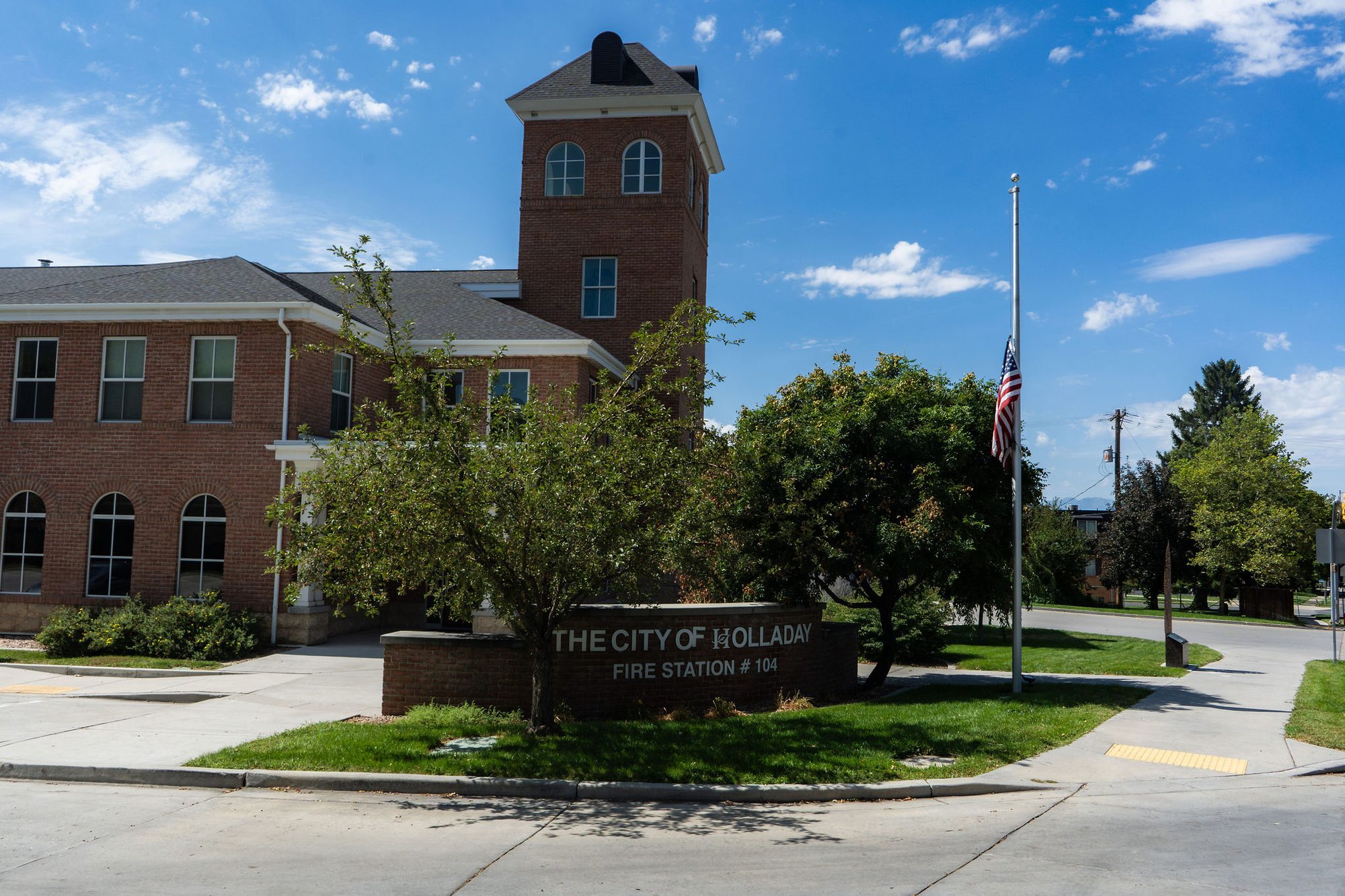
Station 104 in Holladay handled the bulk of responses. It accounted for 369 of 590 engine and truck dispatches, or 62.5%. Station 110 in Cottonwood Heights and Station 112 in Olympus Cove each contributed 73 responses, about 12.4% apiece.
On the ambulance side, Station 104 covered 308 of 445 total responses, or 69.2%. Station 110 in Cottonwood Heights was next at 64, followed by Station 101 in Millcreek at 40.
For emergent calls, the 90th-percentile response time was 7 minutes and 38 seconds, measured from dispatch to arrival. That figure does not include 911 call-processing time, according to the report.
How Holladay's fire response is structured
The report outlined UFA's response model for Holladay. A residential structure fire triggers a first-alarm dispatch of three engines, one truck, one ambulance and two battalion chiefs, totaling seven units and 17 firefighters. Commercial fires add a second truck company, bringing the total to eight units and 28 firefighters.
UFA's modeled travel time for a full residential response force is 9 minutes and 39 seconds at the 90th percentile. The National Fire Protection Association (NFPA) 1710 benchmark for a full alarm to a low- or medium-hazard occupancy is 8 minutes. Both figures measure travel time only, not total time from a 911 call.
The council's work session agenda also included a UPD quarterly report, a public art plan, a Community Development Block Grant (CDBG) update and a discussion of short-term rental options.